General
✓✗All tissues on the inner side of the endodermis, such as pericycle, vascular bundles and pith, constitute the
- periderm
- stele
- ground tissue only
- cortex
General
✓✗Primary xylem is of two types. They are
- protoxylem and metaxylem
- early wood and late wood
- sapwood and heartwood
- tracheids and vessels
General
✓✗In which order does exarch xylem develop?
- Both centripetal and centrifugal
- Irregular
- Centrifugal
- Centripetal
General
✓✗Phloem fibres are generally absent in the
- stems of jute
- primary phloem
- bark of trees
- secondary phloem
General
✓✗Albuminous cells occur in the
- phloem of gymnosperms
- xylem of angiosperms
- xylem of gymnosperms
- cortex of angiosperms
General
✓✗Collenchyma differs from parenchyma in having
- thickening of cellulose, hemicellulose and pectin at the corners
- thin cellulose walls with small intercellular spaces
- living protoplasm with a central vacuole and nucleus
- lignified secondary walls with numerous simple pits
General
✓✗Cork is formed from
- vascular cambium
- cork cambium (phellogen)
- xylem
- phloem
General
✓✗Some trichomes may be
- photosynthetic sieve tubes
- meristematic
- secretory
- conducting elements
General
✓✗Medullary rays are made up of
- sclerenchyma cells
- fibres
- parenchyma cells
- tracheids
General
✓✗Collenchyma occurs in the stems and petioles of
- dicot herbs
- monocots
- hydrophytes
- xerophytes
General
✓✗Which of the following correctly describes the anatomy of a monocot root?
- Two to four xylem bundles and a small pith
- Scattered vascular bundles
- Open vascular bundles in a ring
- More than six xylem bundles (polyarch) and a large, well-developed pith
General
✓✗Centripetal and centrifugal development of primary xylem is seen, respectively, in
- stem and root
- root and stem
- leaf and root
- stem and leaf
General
✓✗Given below is a diagram of a stomatal apparatus. In which of the following are all four parts labelled A, B, C and D correctly identified?
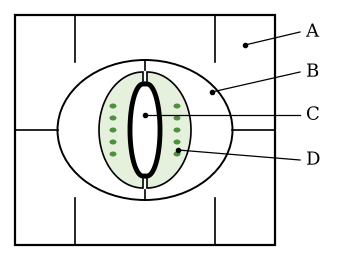
- A - Guard cell, B - Stomatal aperture, C - Subsidiary cell, D - Epidermal cell
- A - Subsidiary cell, B - Epidermal cell, C - Guard cell, D - Stomatal aperture
- A - Epidermal cell, B - Guard cell, C - Stomatal aperture, D - Subsidiary cell
- A - Epidermal cell, B - Subsidiary cell, C - Stomatal aperture, D - Guard cell
General
✓✗Tracheids differ from other tracheary elements in
- lacking a nucleus
- having Casparian strips
- being imperforate
- being lignified
General
✓✗Given below are two statements.
Statement I: Vascular bundles having cambium can form secondary xylem and phloem and are called open.
Statement II: In roots, the vascular bundles are of the conjoint type.
In the light of the above statements, choose the correct answer from the options given below.
Statement I: Vascular bundles having cambium can form secondary xylem and phloem and are called open.
Statement II: In roots, the vascular bundles are of the conjoint type.
In the light of the above statements, choose the correct answer from the options given below.
- Both Statement I and Statement II are correct.
- Both Statement I and Statement II are incorrect.
- Statement I is correct but Statement II is incorrect.
- Statement I is incorrect but Statement II is correct.