General
✓✗A stage of mitosis is shown in the diagram. Which stage is it and what are its characteristics?
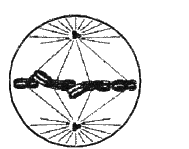

- Late prophase - chromosomes move to spindle equator
- Metaphase - spindle fibres attached to kinetochores, centromeres split and chromatids separate
- Anaphase - centromeres split and chromatids separate and start moving away
- Metaphase - chromosomes moved to spindle equator, chromosomes made up of two sister chromatids
General
✓✗In a bivalent, the number of chromatids present is
- eight
- four
- one
- two
General
✓✗Which statement is correct about prophase I and prophase II?
- Both have five substages.
- Synapsis occurs in prophase II.
- Crossing over occurs only in prophase II.
- Crossing over occurs only in prophase I.
General
✓✗Which of the following correctly matches the phase with the event?
- G2 phase - nuclear division
- M phase - centriole duplication
- S phase - DNA replication
- G1 phase - DNA replication
General
✓✗Chromosomes are made up of two sister chromatids attached together at the
- centromere
- telomere
- satellite
- nucleolus
General
✓✗Gametes formed by meiosis in a diploid organism are
- diploid
- haploid
- triploid
- tetraploid
General
✓✗Given below are two statements.
Statement I: Interphase is called the resting phase because the cell is metabolically inactive.
Statement II: Interphase lasts more than 95 per cent of the duration of the cell cycle.
In the light of the above statements, choose the correct answer from the options given below.
Statement I: Interphase is called the resting phase because the cell is metabolically inactive.
Statement II: Interphase lasts more than 95 per cent of the duration of the cell cycle.
In the light of the above statements, choose the correct answer from the options given below.
- Both Statement I and Statement II are correct.
- Both Statement I and Statement II are incorrect.
- Statement I is correct but Statement II is incorrect.
- Statement I is incorrect but Statement II is correct.
General
✓✗In animal cells, the cleavage furrow
- forms the middle lamella between two daughter cells
- is formed by fusion of vesicles from the Golgi apparatus
- gradually deepens and joins in the centre, dividing the cytoplasm into two
- starts in the centre and grows outwards to the walls
General
✓✗In a 24-hour human cell cycle, interphase lasts about
- 1 hour
- 6 hours
- 12 hours
- 23 hours
General
✓✗Variations produced by meiosis are very important for the process of
- excretion
- evolution
- respiration
- digestion
General
✓✗Crossing over is the exchange of genetic material between
- sister chromatids of a chromosome
- two non-homologous chromosomes
- two daughter cells
- two homologous chromosomes
General
✓✗In a sexually reproducing organism, which two processes together maintain the chromosome number?
- Synapsis and crossing over
- Karyokinesis and interkinesis
- Mitosis and cytokinesis
- Meiosis and fertilisation
General
✓✗In meiosis, DNA replication occurs
- during interkinesis
- before both meiosis I and meiosis II
- only before meiosis II
- once, before meiosis I
General
✓✗The substage of prophase I in which the chromosomes are fully condensed is
- diakinesis
- zygotene
- leptotene
- pachytene
General
✓✗The number of daughter cells formed at the end of meiosis II is
- two
- eight
- one
- four