General
✓✗Assertion: 2-Methylpropan-2-ol does not show optical isomerism.
Reason: It does not contain a chiral carbon atom.
Reason: It does not contain a chiral carbon atom.
- Both Assertion and Reason are true and Reason is the correct explanation of Assertion
- Both Assertion and Reason are true but Reason is not the correct explanation of Assertion
- Assertion is true but Reason is false
- Both Assertion and Reason are false
General
✓✗In Dumas’ method, 0.3 g of an organic compound gave 45 mL of N2 measured at STP. The compound also contains 40% C and 6.67% H, and the rest is oxygen. The percentage of oxygen in it is about
- 20.0%
- 34.6%
- 46.7%
- 53.3%
General
✓✗In Carius method, 0.20 g of an organic compound gave 0.287 g of AgCl. The percentage of chlorine is (Ag = 108, Cl = 35.5)
- 17.75%
- 35.5%
- 71.0%
- 28.7%
General
✓✗The IUPAC name of the compound CH3CH=CHC≡CH is
- pent-1-yn-3-ene
- pent-2-en-4-yne
- pent-3-en-1-yne
- pent-4-yn-2-ene
General
✓✗In Kjeldahl’s method, the ammonia from 0.5 g of an organic compound neutralised 10 mL of 1 M H2SO4. The percentage of nitrogen is
- 14%
- 28%
- 42%
- 56%
General
✓✗Compounds containing one or more benzene rings are classified as
- alicyclic compounds
- aromatic compounds
- aliphatic compounds
- heterocyclic compounds only
General
✓✗The number of monochloro structural isomers of n-pentane is
- 5
- 2
- 3
- 4
General
✓✗Which of the following statements about free radicals is correct?
- They carry a positive charge
- They are formed by heterolytic fission
- They have a complete octet on carbon
- They are neutral species with an unpaired electron and are highly reactive
General
✓✗An sp3 hybrid orbital contains
- 1/2 s-character
- 1/4 s-character
- 1/3 s-character
- 2/3 s-character
General
✓✗In Lassaigne’s extract of an organic compound, both nitrogen and sulphur are present, which gives a blood-red colour with Fe3+ due to the formation of
- [Fe(SCN)]2+
- NaSCN
- [Fe(CN)5NOS]4−
- Fe4[Fe(CN)6]3.xH2O
General
✓✗How many structural isomers are possible for dichlorobenzene?
- 4
- 3
- 6
- 2
General
✓✗Which of the following does NOT show hyperconjugation?
- CH3CH2−CH=CH2
- CH3−CH=CH2
- (CH3)2CH−CH=CH2
- (CH3)3C−CH=CH2
General
✓✗Statement I: Free radicals are formed by homolytic fission.
Statement II: Carbocations are formed by heterolytic fission.
Statement II: Carbocations are formed by heterolytic fission.
- Both Statement I and Statement II are correct
- Both Statement I and Statement II are incorrect
- Statement I is correct but Statement II is incorrect
- Statement I is incorrect but Statement II is correct
General
✓✗The correct IUPAC name for the following compound (taking the main chain to include the double bond, as in NCERT) is
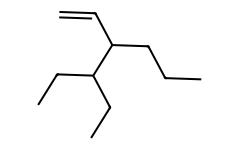
- 4-ethyl-3-propylhex-1-ene
- 3-ethyl-4-propylhex-5-ene
- 3-ethyl-4-ethenylheptane
- 3-(1-ethylpropyl)hex-1-ene
General
✓✗In CH2=C=CH2 (allene), the hybridisation of the carbons from left to right is
- sp, sp2, sp
- sp2, sp, sp2
- sp2, sp2, sp2
- sp3, sp, sp3