General
✓✗A body of mass 1 kg tied to a string 0.5 m long moves in a horizontal circle at 2 rev/s. The tension in the string is (π2 ≈ 10)
- 40 N
- 20 N
- 160 N
- 80 N
General
✓✗A 1 kg ball tied to a 1 m string is whirled in a vertical circle. At the lowest point its speed is 6 m s−1. The tension at the lowest point is (g = 10 m s−2)
- 26 N
- 36 N
- 46 N
- 16 N
General
✓✗Block A (4 kg) is on top of block B (6 kg) on a frictionless floor; μs = μk = 0.5 between them. A horizontal force of 40 N acts on B. The acceleration of A is (g = 10 m s−2)
- 2.5 m s−2
- 5 m s−2
- 0
- 4 m s−2
General
✓✗A block of mass 10 kg is placed on a rough incline of 30° (μs = 0.5). The minimum force parallel to the incline needed to push it up is (g = 10 m s−2)
- 50 N
- 43.3 N
- 93.3 N
- 6.7 N
General
✓✗A system consists of three masses m1, m2 and m3 connected by a string passing over a pulley P. The mass m1 hangs freely, and m2 and m3 are on a rough horizontal table (coefficient of friction μ). The pulley is frictionless and of negligible mass.
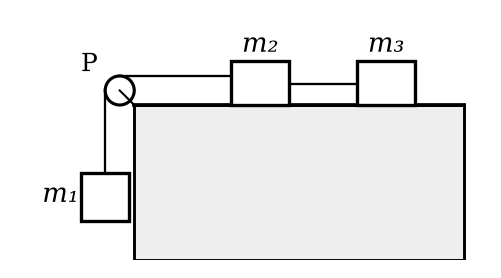
If m1 = m2 = m3 = m, the downward acceleration of m1 is
If m1 = m2 = m3 = m, the downward acceleration of m1 is
- \( \dfrac{g(1 - 2\mu)}{3} \)
- \( \dfrac{g(1 - \mu)}{3} \)
- \( \dfrac{g(1 - 2\mu)}{2} \)
- \( \dfrac{2g\mu}{3} \)
General
✓✗A body of mass 10 kg moving at 20 m s−1 is stopped in 4 s by a constant force. The distance travelled before stopping is
- 40 m
- 160 m
- 20 m
- 80 m
General
✓✗Which of the following is a non-inertial frame of reference?
- A train moving on a straight track at constant speed
- A ship sailing on a straight course at constant velocity
- A car going round a curve at constant speed
- A lift moving up at constant speed
General
✓✗A cyclist moving at 18 km h−1 takes a turn of radius 3 m on a level road. If the coefficient of static friction is 0.1, the cyclist (g = 9.8 m s−2) (NCERT)
- will topple outward without slipping
- will slip, since v2 > μrg
- will not slip
- will slip only if he slows down
General
✓✗A force of 50 N acts on a body for 0.2 s. The impulse imparted is
- 0.4 N s
- 10 N s
- 250 N s
- 50.2 N s
General
✓✗A body of mass 4 kg is acted upon by two perpendicular forces of 6 N and 8 N. The magnitude of its acceleration is
- 3.5 m s−2
- 14 m s−2
- 2.5 m s−2
- 0.5 m s−2
General
✓✗A horse pulls a cart. According to the third law the cart pulls the horse with an equal force. The system moves forward because
- action and reaction cancel each other
- the horse is heavier than the cart
- the cart's force on the horse is smaller
- the ground pushes the horse forward with a friction force larger than the backward pull of the cart
General
✓✗A trolley of mass 300 kg carrying a sandbag of 25 kg moves uniformly at 27 km h−1 on a frictionless track. After a while sand starts leaking out of a hole on the floor of the trolley. The speed of the trolley after the entire sandbag is empty is (NCERT)
- 27 km h−1
- less than 27 km h−1
- more than 27 km h−1
- zero
General
✓✗A shell in flight explodes into four unequal parts. Which of the following is conserved during the explosion?
- Momentum
- Potential energy
- Kinetic energy
- Both potential energy and kinetic energy
General
✓✗A force of 20 N acts on a body of mass 4 kg. The acceleration produced is
- 80 m s−2
- 0.2 m s−2
- 5 m s−2
- 16 m s−2
General
✓✗A ball of mass 0.2 kg strikes the ground vertically at 10 m s−1 and rebounds at 8 m s−1. The change in momentum is
- 0.4 kg m s−1 upward
- 3.6 kg m s−1 upward
- 0.4 kg m s−1 downward
- 3.6 kg m s−1 downward