General
✓✗Two forces \( \vec{P} \) and \( \vec{Q} \) with resultant \( \vec{R} \) are such that \( \vec{R} \) is perpendicular to \( \vec{P} \) and |R| = |P|. The angle between \( \vec{P} \) and \( \vec{Q} \) is
- 120°
- 45°
- 135°
- 90°
General
✓✗A body just begins to slide on an inclined plane when the angle of inclination is 30°. The coefficient of static friction is
- \( \dfrac{1}{2} \)
- \( \dfrac{\sqrt{3}}{2} \)
- \( \sqrt{3} \)
- \( \dfrac{1}{\sqrt{3}} \)
General
✓✗A bullet is fired from a gun. The force on the bullet is given by F = 600 − 2 × 10⁵ t, where F is in newton and t in seconds. The force on the bullet becomes zero just as it leaves the barrel. The impulse imparted to the bullet is
- 1.8 N s
- zero
- 9 N s
- 0.9 N s
General
✓✗A mass M is placed on a very smooth wedge of inclination θ resting on a frictionless surface, as shown.
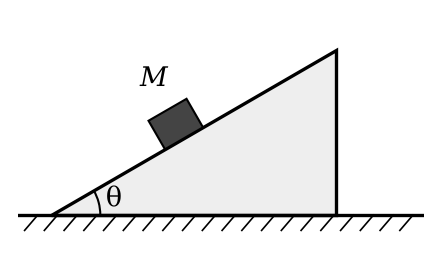
The acceleration a to be given to the wedge so that M remains at rest relative to the wedge is
The acceleration a to be given to the wedge so that M remains at rest relative to the wedge is
- towards the right, a = g tanθ
- towards the left, a = g tanθ
- towards the left, a = g cosθ
- towards the left, a = g sinθ
General
✓✗Two blocks of masses 1 kg and 2 kg are connected by a compressed spring and held at rest on a frictionless table. When released, the 2 kg block moves at 1.5 m s−1. The 1 kg block moves at
- 3 m s−1
- 0.75 m s−1
- 1.5 m s−1
- 6 m s−1
General
✓✗The force on a body varies with time as F = 6t2 (N, s). The impulse delivered between t = 1 s and t = 2 s is
- 6 N s
- 24 N s
- 18 N s
- 14 N s
General
✓✗A cricketer catches a ball of mass 150 g moving with a speed of 20 m s−1 and brings it to rest in 0.1 s. The average force he experiences is
- 0.3 N
- 300 N
- 30 N
- 3 N
General
✓✗A particle moving with velocity \( \vec{v} \) is acted upon by three forces represented by the sides of the vector triangle PQR taken in order, as shown.
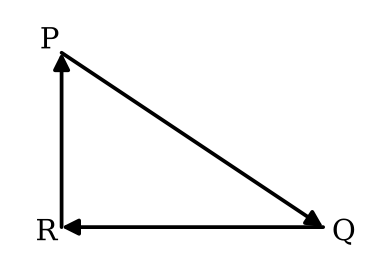
The velocity of the particle will
The velocity of the particle will
- decrease
- change according to the force \( \overrightarrow{QR} \) alone
- remain constant
- increase
General
✓✗A truck and a car have the same momentum. Which one has the greater speed?
- The car
- The truck
- Both have equal speeds
- Cannot be decided
General
✓✗Statement I: Action and reaction forces never cancel each other.
Statement II: Action and reaction act on different bodies.
Statement II: Action and reaction act on different bodies.
- Both Statement I and Statement II are correct
- Both Statement I and Statement II are incorrect
- Statement I is correct but Statement II is incorrect
- Statement I is incorrect but Statement II is correct
General
✓✗A block of mass m on a smooth incline of 30° is connected over a pulley at the top to a hanging block of the same mass m. The acceleration of the system is
- g
- \( \dfrac{g}{2} \)
- \( \dfrac{3g}{4} \)
- \( \dfrac{g}{4} \)
General
✓✗A mass of 1 kg is suspended by a thread. It is (i) lifted up with an acceleration of 4.9 m s−2, and (ii) lowered with an acceleration of 4.9 m s−2. The ratio of the tensions in the two cases is (take g = 9.8 m s−2)
- 1 : 2
- 2 : 1
- 3 : 1
- 1 : 3
General
✓✗A bucket of water is whirled in a vertical circle of radius 1 m. The minimum speed at the top so that water does not fall out is (g = 10 m s−2)
- \( \sqrt{20} \) m s−1
- 1 m s−1
- \( \sqrt{10} \) m s−1
- 10 m s−1
General
✓✗A block of 5 kg hangs from a string attached to the ceiling of a car accelerating horizontally at 5 m s−2. The tension in the string is (g = 10 m s−2)
- 50 N
- 75 N
- \( 25\sqrt{5} \) N
- 25 N
General
✓✗A 60 kg man on frictionless ice throws a 2 kg ball horizontally at 15 m s−1. The man recoils with a speed of
- 2 m s−1
- 0.5 m s−1
- 0.05 m s−1
- 5 m s−1