General
✓✗A body of mass 3 kg hits a wall with a speed of 10 m s−1 at an angle of 60° with the wall and rebounds with the same speed at the same angle, as shown.
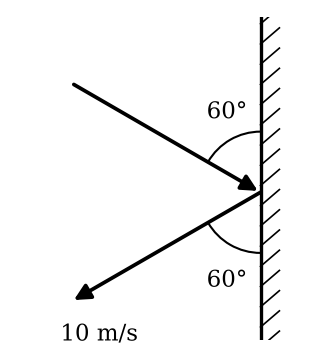
The impact time is 0.2 s. The average force exerted on the wall is

The impact time is 0.2 s. The average force exerted on the wall is
- \( 150\sqrt{3} \) N
- \( 50\sqrt{3} \) N
- \( 75\sqrt{3} \) N
- 100 N
General
✓✗A block of mass 2 kg on a rough horizontal surface (μ = 0.25) is pulled by a force of 10 N at 37° above the horizontal. Its acceleration is (g = 10 m s−2, sin37° = 0.6)
- 4 m s−2
- 2.25 m s−2
- 3.25 m s−2
- 1.5 m s−2
General
✓✗A force acts on a body of mass 5 kg and changes its velocity from 2 m s−1 to 8 m s−1 in 3 s. The force is
- 6 N
- 10 N
- 50 N
- 30 N
General
✓✗A passenger standing in a bus falls backwards when the bus suddenly starts. This is due to
- inertia of direction
- inertia of motion
- inertia of rest
- the third law of motion
General
✓✗A helicopter of mass 1000 kg carrying crew and passengers of mass 300 kg rises with a vertical acceleration of 15 m s−2. The action of the rotor of the helicopter on the surrounding air is (g = 10 m s−2) (NCERT)
- 32500 N downwards
- 32500 N upwards
- 13000 N downwards
- 25000 N downwards
General
✓✗A block takes time t to slide down a smooth incline and time 3t to slide down the same incline when it is rough. If the incline angle is 45°, the coefficient of kinetic friction is
- \( \dfrac{1}{3} \)
- \( \dfrac{2}{3} \)
- \( \dfrac{8}{9} \)
- \( \dfrac{1}{9} \)
General
✓✗The maximum speed at which a car can go round a level curve of radius r is v. On a curve of radius 4r with the same road surface, the maximum speed is
- \( \dfrac{v}{2} \)
- v
- 4v
- 2v
General
✓✗A string over a fixed pulley connects masses m and 3m. The force on the pulley support (pulley and string light) when they move is
- 6mg
- 4mg
- 2mg
- 3mg
General
✓✗The minimum force needed to move a block of weight W on a rough horizontal surface (coefficient of friction μ), applied at the best angle, is
- \( \mu W \)
- \( \dfrac{\mu W}{\sqrt{1 + \mu^2}} \)
- \( \dfrac{W}{\sqrt{1 + \mu^2}} \)
- \( \mu W\sqrt{1 + \mu^2} \)
General
✓✗The position of a 2 kg particle is x = 3t2 m, where t is in seconds. The force acting on it is
- 6 N
- 12 N
- 24 N
- 3 N
General
✓✗Roads are banked on curves so that
- a component of the normal force provides the centripetal force
- the weight of the vehicle is reduced
- the vehicle can move faster on straight roads
- friction is increased
General
✓✗The force of friction always acts
- opposite to the relative motion (or tendency of relative motion) between surfaces
- in the direction of motion
- towards the centre of the earth
- perpendicular to the surface
General
✓✗A body of mass 2 kg moves under a force that varies as F = (20 − 4t) N, starting from rest. The maximum speed attained is
- 100 m s−1
- 50 m s−1
- 12.5 m s−1
- 25 m s−1
General
✓✗A 5000 kg rocket is set for vertical firing. The exhaust speed is 800 m s−1. To give an initial upward acceleration of 20 m s−2, the amount of gas ejected per second to supply the needed thrust is (g = 10 m s−2)
- 185.5 kg s−1
- 127.5 kg s−1
- 137.5 kg s−1
- 187.5 kg s−1
General
✓✗A 40 kg slab rests on a frictionless floor and a 10 kg block rests on it. The coefficients of static and kinetic friction between block and slab are 0.6 and 0.4. A horizontal force of 100 N acts on the block. The acceleration of the block is (g = 10 m s−2)
- 10 m s−2
- 1 m s−2
- 4 m s−2
- 6 m s−2