General
✓✗If \( \vec{A} = 3\hat{i} + 4\hat{j} \) and \( \vec{B} = \hat{i} - 2\hat{j} \), then \( \vec{A} + \vec{B} \) is
- \( 3\hat{i} - 8\hat{j} \)
- \( 2\hat{i} + 6\hat{j} \)
- \( 4\hat{i} + 2\hat{j} \)
- \( 4\hat{i} + 6\hat{j} \)
General
✓✗A projectile has the same range for angles θ and (90° − θ). If H1 and H2 are the maximum heights, the range R equals
- \( H_1 + H_2 \)
- \( \sqrt{H_1H_2} \)
- \( 2\sqrt{H_1H_2} \)
- \( 4\sqrt{H_1H_2} \)
General
✓✗If \( \vec{A} = 2\hat{i} + \hat{j} - \hat{k} \) and \( \vec{B} = \hat{i} - \hat{j} + 2\hat{k} \), then \( \vec{A}\cdot\vec{B} \) is
- 5
- 3
- −1
- 1
General
✓✗Two forces of 3 N and 4 N act on a body at right angles to each other. The magnitude of their resultant is
- 7 N
- 12 N
- 5 N
- 1 N
General
✓✗The speed of a projectile at its maximum height is half of its initial speed. The angle of projection is
- 15°
- 45°
- 60°
- 30°
General
✓✗A body is thrown horizontally from the top of a tower and strikes the ground 3 s later at an angle of 45° with the horizontal. Its speed of projection was (take g = 10 m s−2)
- 10 m/s
- 30 m/s
- 15 m/s
- 45 m/s
General
✓✗In uniform circular motion, the speed of the particle
- increases
- decreases
- is zero
- remains constant
General
✓✗For the vector of magnitude 10 units at 30° to the x-axis, the y-component is
- 8.66
- 10
- 5
- \( 5\sqrt{3} \)
General
✓✗The velocity of a projectile at the initial point A is \( (2\hat{i} + 3\hat{j}) \) m/s.
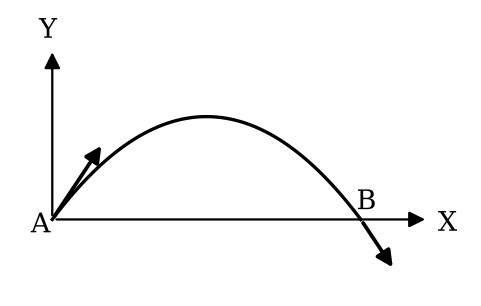
Its velocity (in m/s) at point B is
Its velocity (in m/s) at point B is
- \( -2\hat{i} + 3\hat{j} \)
- \( -2\hat{i} - 3\hat{j} \)
- \( 2\hat{i} - 3\hat{j} \)
- \( 2\hat{i} + 3\hat{j} \)
General
✓✗In two-dimensional motion, the instantaneous velocity at a point is directed
- towards the origin
- along the position vector
- perpendicular to the path
- along the tangent to the path at that point
General
✓✗The angle between \( \vec{A} = \hat{i} + \hat{j} \) and \( \vec{B} = \hat{i} - \hat{j} \) is
- 45°
- 0°
- 90°
- 180°
General
✓✗A projectile is thrown from the ground. Which of the following are correct (air resistance neglected)?
A. The vertical component of momentum changes uniformly with time.
B. The kinetic energy is minimum at the highest point.
C. The acceleration is perpendicular to the velocity throughout the flight.
D. The path is symmetric about the vertical line through the highest point.
Choose the correct answer from the options given below.
- A, B and D only
- A, B and C only
- B, C and D only
- A, B, C and D
General
✓✗A stone tied to the end of a string 1 m long is whirled in a horizontal circle with a constant speed. If the stone makes 22 revolutions in 44 seconds, the magnitude and direction of the acceleration of the stone are
- \( \pi^2\ \text{m s}^{-2} \), along the radius towards the centre
- \( \pi^2\ \text{m s}^{-2} \), along the radius away from the centre
- \( \pi^2\ \text{m s}^{-2} \), along the tangent to the circle
- \( \dfrac{\pi^2}{4}\ \text{m s}^{-2} \), along the radius towards the centre
General
✓✗A bus is moving on a straight road towards the north with a uniform speed of 50 km/h. It then turns left through 90°. If the speed remains unchanged after turning, the increase in the velocity of the bus in the turning process is
- 70.7 km/h along north-west
- zero
- 70.7 km/h along south-west
- 50 km/h along west
General
✓✗A vector lies along the negative y-axis with magnitude 5. In unit-vector form it is
- \( 5\hat{j} \)
- \( -5\hat{j} \)
- \( -5\hat{i} \)
- \( 5\hat{i} \)