General
✓✗The magnitude of the vector \( \vec{A} = 2\hat{i} + 3\hat{j} + 6\hat{k} \) is
- \( \sqrt{11} \)
- 49
- 7
- 11
General
✓✗In two-dimensional motion, the instantaneous velocity at a point is directed
- towards the origin
- along the position vector
- perpendicular to the path
- along the tangent to the path at that point
General
✓✗The torque of a force \( \vec{F} = 2\hat{j} \) N acting at the point \( \vec{r} = 3\hat{i} \) m, about the origin, is
- \( -6\hat{k} \) N m
- 6 N m along \( \hat{j} \)
- \( 6\hat{i} \) N m
- \( 6\hat{k} \) N m
General
✓✗A projectile is thrown from the ground. Which of the following are correct (air resistance neglected)?
A. The vertical component of momentum changes uniformly with time.
B. The kinetic energy is minimum at the highest point.
C. The acceleration is perpendicular to the velocity throughout the flight.
D. The path is symmetric about the vertical line through the highest point.
Choose the correct answer from the options given below.
- A, B and D only
- A, B and C only
- B, C and D only
- A, B, C and D
General
✓✗Assertion: The horizontal range of a projectile is the same for angles of projection θ and (90° − θ).
Reason: The range depends on sin 2θ.
Reason: The range depends on sin 2θ.
- Both Assertion and Reason are true and Reason is the correct explanation of Assertion
- Both Assertion and Reason are true but Reason is not the correct explanation of Assertion
- Assertion is true but Reason is false
- Both Assertion and Reason are false
General
✓✗A particle moves from (1 m, 2 m) to (4 m, 6 m) in the x-y plane. Its displacement vector is
- \( 5\hat{i} + 8\hat{j} \) m
- \( 3\hat{i} + 4\hat{j} \) m
- \( -3\hat{i} - 4\hat{j} \) m
- \( 4\hat{i} + 6\hat{j} \) m
General
✓✗If \( \vec{A} = 2\hat{i} + \hat{j} - \hat{k} \) and \( \vec{B} = \hat{i} - \hat{j} + 2\hat{k} \), then \( \vec{A}\cdot\vec{B} \) is
- 5
- 3
- −1
- 1
General
✓✗A boat rows straight across a river (heading perpendicular to the banks) at 4 km/h relative to the water. The river flows at 3 km/h. The speed of the boat relative to the ground is
- 4 km/h
- 1 km/h
- 7 km/h
- 5 km/h
General
✓✗A particle moves on a circle of radius 1 m at 2 rad/s. Its speed and centripetal acceleration are
- 1 m/s and 4 m s−2
- 4 m/s and 2 m s−2
- 2 m/s and 4 m s−2
- 2 m/s and 2 m s−2
General
✓✗The resultant of two equal forces is equal to either of them. The angle between the forces is
- 60°
- 150°
- 120°
- 90°
General
✓✗The position of a particle is \( \vec{r} = 3t\,\hat{i} - 2t^2\,\hat{j} + 4\hat{k} \) m. The magnitude of its acceleration is
- 8 m s−2
- 2 m s−2
- 4 m s−2
- 0
General
✓✗A particle is projected horizontally with speed u from height h. The angle its velocity makes with the horizontal when it hits the ground is
- \( \tan^{-1}\left(\dfrac{2gh}{u}\right) \)
- \( \tan^{-1}\left(\dfrac{\sqrt{2gh}}{u}\right) \)
- 45°
- \( \tan^{-1}\left(\dfrac{u}{\sqrt{2gh}}\right) \)
General
✓✗Two cars move at 30 km/h, one due east and the other due north. The magnitude of the velocity of one relative to the other is
- 60 km/h
- \( 30\sqrt{2} \) km/h
- 30 km/h
- zero
General
✓✗A boat is sent across a river with a velocity of 8 km h−1. If the resultant velocity of the boat is 10 km h−1, then the velocity of the river is
- 6 km h−1
- 10 km h−1
- 12.8 km h−1
- 8 km h−1
General
✓✗Six vectors \( \vec{a} \) through \( \vec{f} \) have the magnitudes and directions indicated in the figure.
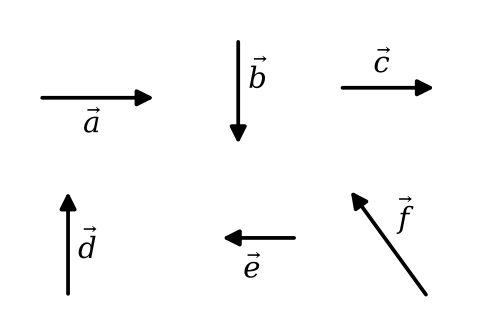
Which of the following statements is true?
Which of the following statements is true?
- \( \vec{b} + \vec{c} = \vec{f} \)
- \( \vec{b} + \vec{e} = \vec{f} \)
- \( \vec{d} + \vec{e} = \vec{f} \)
- \( \vec{d} + \vec{c} = \vec{f} \)