General
✓✗A particle rotates with angular velocity \( \vec{\omega} = 5\hat{i} - 6\hat{j} + 6\hat{k} \) and its position vector is \( \vec{r} = 3\hat{i} - 4\hat{j} + \hat{k} \). Its linear velocity \( \vec{v} = \vec{\omega}\times\vec{r} \) is
- \( 18\hat{i} + 13\hat{j} - 2\hat{k} \)
- \( 4\hat{i} - 13\hat{j} + 6\hat{k} \)
- \( 6\hat{i} + 2\hat{j} - 3\hat{k} \)
- \( 6\hat{i} - 2\hat{j} + 8\hat{k} \)
General
✓✗A particle is projected from the ground. At a height of 0.4 m its velocity is \( (6\hat{i} + 2\hat{j}) \) m/s (\( \hat{j} \) vertical). Its horizontal range is about (take g = 10 m s−2)
- 6 m
- 4.8 m
- 4.2 m
- 3.6 m
General
✓✗If \( \vec{A} = 3\hat{i} + 4\hat{j} \) and \( \vec{B} = \hat{i} - 2\hat{j} \), then \( \vec{A} - \vec{B} \) is
- \( 2\hat{i} + 6\hat{j} \)
- \( 4\hat{i} + 2\hat{j} \)
- \( 2\hat{i} + 2\hat{j} \)
- \( -2\hat{i} - 6\hat{j} \)
General
✓✗A projectile is fired at 45° with kinetic energy K. Its kinetic energy at the highest point is
- K
- zero
- \( \dfrac{K}{\sqrt{2}} \)
- \( \dfrac{K}{2} \)
General
✓✗Two vectors of magnitudes 3 and 5 units have a resultant of magnitude 7 units. The angle between them is
- 30°
- 120°
- 90°
- 60°
General
✓✗A particle starts from the origin at t = 0 with velocity \( 5\hat{i} \) m/s and moves in the x-y plane with constant acceleration \( (2\hat{i} + 4\hat{j}) \) m s−2. Its y-coordinate when its x-coordinate is 24 m is
- 36 m
- 18 m
- 9 m
- 24 m
General
✓✗A particle moves in a circle of radius r with constant angular acceleration α, starting from rest. The angle between its total acceleration and its velocity at time t is
- \( \tan^{-1}(\alpha t^2) \)
- \( \tan^{-1}(\alpha t) \)
- 45°
- \( \tan^{-1}\left(\dfrac{1}{\alpha t^2}\right) \)
General
✓✗Which pair consists of one scalar and one vector quantity?
- Speed and velocity
- Work and energy
- Force and momentum
- Mass and time
General
✓✗A particle is projected from the ground with velocity \( (3\hat{i} + 4\hat{j}) \) m/s (\( \hat{j} \) vertical). The equation of its trajectory is (take g = 10 m s−2)
- \( y = 4x - 5x^2 \)
- \( y = \dfrac{3}{4}x - \dfrac{5}{16}x^2 \)
- \( y = \dfrac{4}{3}x - \dfrac{5}{3}x^2 \)
- \( y = \dfrac{4}{3}x - \dfrac{5}{9}x^2 \)
General
✓✗A boat whose speed in still water is 3 m/s crosses a 120 m wide river flowing at 5 m/s. The minimum possible drift downstream is
- 200 m
- 160 m
- 90 m
- 120 m
General
✓✗The coordinates of a moving particle are \( x = at^2 \) and \( y = bt^2 \). The speed of the particle is
- \( 2\sqrt{a^2 + b^2} \)
- \( 2t\sqrt{a^2 + b^2} \)
- \( t\sqrt{a^2 + b^2} \)
- \( 2t(a + b) \)
General
✓✗A boat crosses a river heading perpendicular to the flow (see figure). The time to cross depends on
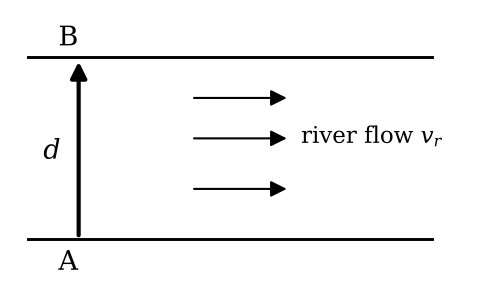
- the river width and the boat’s speed relative to water
- the drift only
- both speeds and the drift
- the river’s speed only
General
✓✗A particle moves along a circle of radius R with constant speed. The magnitude of its average acceleration over a quarter revolution, taking time t, is
- \( \dfrac{v^2}{R} \)
- \( \dfrac{\sqrt2 v}{t} \)
- zero
- \( \dfrac{v}{t} \)
General
✓✗The horizontal range of a projectile is four times its maximum height. The angle of projection is
- 60°
- 30°
- \( \tan^{-1}(4) \)
- 45°
General
✓✗A body A of mass M is thrown with velocity v at an angle of 30° to the horizontal, and another body B of the same mass is thrown with the same speed at an angle of 60° to the horizontal. The ratio of the horizontal range of A to that of B will be
- \( \sqrt{3} : 1 \)
- 1 : 1
- \( 1 : \sqrt{3} \)
- 1 : 3