General
✓✗For the tap of the previous question (drops every 1 s; the first drop hits the ground as the fifth leaves the tap), the height of the second drop above the ground at that instant is (take g = 10 m s−2)
- 60 m
- 35 m
- 45 m
- 20 m
General
✓✗A man walks 10 m east, 10 m north and then 10 m west. His displacement from the starting point is
- 30 m
- zero
- 10 m north
- 10 m east
General
✓✗A body covers 20 m in the first 2 s and 30 m in the next 3 s along a straight line in the same direction. Its average velocity is
- 10 m/s
- 5 m/s
- 12.5 m/s
- 25 m/s
General
✓✗Assertion: The magnitude of the instantaneous velocity of a body is equal to its instantaneous speed.
Reason: Over an infinitesimally small time interval, the magnitude of displacement equals the path length.
Reason: Over an infinitesimally small time interval, the magnitude of displacement equals the path length.
- Both Assertion and Reason are true and Reason is the correct explanation of Assertion
- Both Assertion and Reason are true but Reason is not the correct explanation of Assertion
- Assertion is true but Reason is false
- Both Assertion and Reason are false
General
✓✗Two bodies A and B move along a straight line with velocities vA and vB. The relative velocity of A with respect to B is
- \( v_A + v_B \)
- \( v_A - v_B \)
- \( \dfrac{v_A + v_B}{2} \)
- \( v_B - v_A \)
General
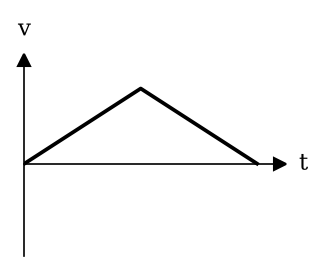
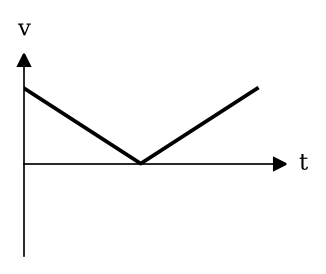
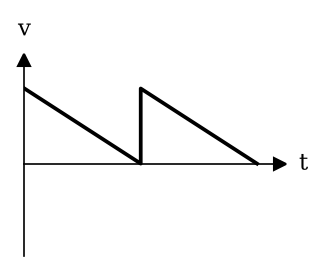
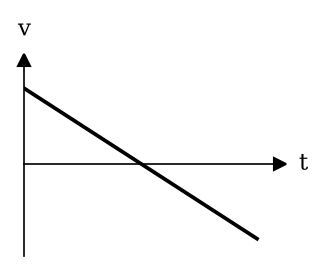
✓✗A ball is thrown vertically upwards and caught by the thrower. Which graph shows its speed (magnitude of velocity) against time?
General
✓✗A train of length 150 m is going towards the north at a speed of 10 m/s. A parrot flies at 5 m/s towards the south, parallel to the railway track. The time taken by the parrot to cross the train is
- 8 s
- 12 s
- 10 s
- 15 s
General
✓✗A straight-line position-time graph of a moving body that makes an angle of 45° with the time axis (equal scales) indicates a velocity of
- 1 unit
- 0
- infinite
- √2 units
General
✓✗Two balls are thrown simultaneously, A vertically upwards with 20 m/s and B vertically downwards with 20 m/s, from the same point high above the ground. Their separation after 2 s is
- 80 m
- 20 m
- 0
- 40 m
General
✓✗The acceleration of a particle is increasing linearly with time t as bt. The particle starts from the origin with an initial velocity v0. The distance travelled by the particle in time t will be
- \( v_0t + \dfrac{1}{3}bt^2 \)
- \( v_0t + \dfrac{1}{6}bt^3 \)
- \( v_0t + \dfrac{1}{2}bt^2 \)
- \( v_0t + \dfrac{1}{3}bt^3 \)
General
✓✗A man throws balls with the same speed vertically upwards, one after the other, at an interval of 2 seconds. What should be the speed of the throw so that more than two balls are in the sky at any time? (Given g = 9.8 m s−2)
- more than 19.6 m/s
- at least 9.8 m/s
- any speed less than 19.6 m/s
- only with speed 19.6 m/s
General
✓✗The ratio of the distances travelled by a freely falling body in the 1st, 2nd, 3rd and 4th seconds is
- 1 : 1 : 1 : 1
- 1 : 4 : 9 : 16
- 1 : 2 : 3 : 4
- 1 : 3 : 5 : 7
General
✓✗Two cars move in the same direction on a straight road with speeds of 60 km/h and 40 km/h. The relative speed of the faster car with respect to the slower one is
- 2400 km/h
- 50 km/h
- 100 km/h
- 20 km/h
General
✓✗The position of a particle varies as \( x = 6t - t^2 \) (x in m, t in s). Its displacement in the first 4 s is
- 10 m
- 8 m
- 16 m
- 9 m
General
✓✗Assertion: The velocity-time graph of a body can never be a vertical line.
Reason: A vertical line would mean infinite acceleration.
Reason: A vertical line would mean infinite acceleration.
- Both Assertion and Reason are true and Reason is the correct explanation of Assertion
- Both Assertion and Reason are true but Reason is not the correct explanation of Assertion
- Assertion is true but Reason is false
- Both Assertion and Reason are false