General
✓✗A uniform disc of radius R is put over another uniform disc of radius 2R of the same thickness and density, with the edges touching at one point and the planes parallel. The moment of inertia of the combination about an axis through the centre of the larger disc perpendicular to the plane is (M = mass of the smaller disc)
- 9MR2
- \( \dfrac{17}{2}MR^2 \)
- \( \dfrac{19}{2}MR^2 \)
- 10MR2
General
✓✗A particle of mass 1 kg is projected with speed 20 m s−1 at 45° to the horizontal. The magnitude of its angular momentum about the point of projection just before it lands is (g = 10 m s−2)
- \( 400\sqrt2 \) kg m2 s−1
- \( 200\sqrt2 \) kg m2 s−1
- 400 kg m2 s−1
- 800 kg m2 s−1
General
✓✗The angular displacement of a wheel is θ = 3t2 + 2t (in rad, t in s). Its angular acceleration is
- 6 rad/s2
- 3 rad/s2
- 2 rad/s2
- it increases with time
General
✓✗A flywheel of moment of inertia 0.4 kg m2 is rotating at 10 rev/s. Its kinetic energy is about (π2 ≈ 10)
- 20 J
- 80 J
- 400 J
- 800 J
General
✓✗The angular momentum of a body changes from 20 to 50 kg m2 s−1 in 5 s. The average torque on it is
- 10 N m
- 14 N m
- 150 N m
- 6 N m
General
✓✗A hollow sphere rolls without slipping. The fraction of its total kinetic energy that is rotational is
- 2/3
- 1/2
- 2/5
- 3/5
General
✓✗The moment of inertia of a thin uniform rod of mass m and length l about an axis through one end making an angle θ with the rod is
- \( \dfrac{ml^2\sin^2\theta}{3} \)
- \( \dfrac{ml^2\cos^2\theta}{3} \)
- \( \dfrac{ml^2}{3} \)
- \( \dfrac{ml^2\sin^2\theta}{12} \)
General
✓✗A wheel has an angular acceleration of 3.0 rad/s2 and an initial angular speed of 2.00 rad/s. In a time of 2 s it has rotated through an angle (in radian) of
- 12
- 4
- 10
- 6
General
✓✗Statement I: For a body rolling without slipping, the work done by static friction is zero.
Statement II: The velocity of the contact point of a body rolling without slipping is zero.
Statement II: The velocity of the contact point of a body rolling without slipping is zero.
- Both Statement I and Statement II are correct
- Both Statement I and Statement II are incorrect
- Statement I is correct but Statement II is incorrect
- Statement I is incorrect but Statement II is correct
General
✓✗Statement I: For a rigid body rotating about a fixed axis, the angular velocity is the same for all particles.
Statement II: For a rigid body rotating about a fixed axis, the linear speed is the same for all particles.
Statement II: For a rigid body rotating about a fixed axis, the linear speed is the same for all particles.
- Both Statement I and Statement II are correct
- Both Statement I and Statement II are incorrect
- Statement I is correct but Statement II is incorrect
- Statement I is incorrect but Statement II is correct
General
✓✗A uniform rod of mass 3 kg and length 2 m rotates about an axis through one end perpendicular to it. Its moment of inertia is
- 4 kg m2
- 12 kg m2
- 1 kg m2
- 2 kg m2
General
✓✗Two particles of mass 5 kg and 10 kg respectively are attached to the two ends of a rigid rod of length 1 m with negligible mass. The centre of mass of the system from the 5 kg particle is nearly at a distance of
- 80 cm
- 50 cm
- 67 cm
- 33 cm
General
✓✗A uniform disc of radius 0.2 m and mass 5 kg rotates about an axis through a point on its rim perpendicular to its plane. Its moment of inertia is
- 0.15 kg m2
- 0.1 kg m2
- 0.2 kg m2
- 0.3 kg m2
General
✓✗A wheel of moment of inertia 0.5 kg m2 rotating at 20 rad/s is stopped by a constant frictional torque in 10 s. The frictional torque is
- 0.5 N m
- 10 N m
- 2 N m
- 1 N m
General
✓✗A uniform rod of length 200 cm and mass 500 g is balanced on a wedge placed at the 40 cm mark. A mass of 2 kg is suspended from the rod at 20 cm and another unknown mass m is suspended from the rod at the 160 cm mark, as shown in the figure.
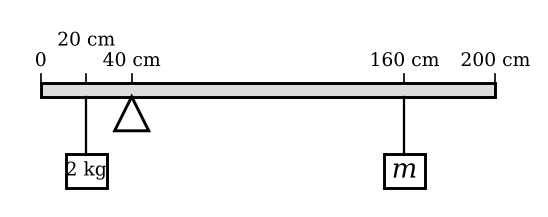
Find the value of m such that the rod is in equilibrium. (g = 10 m s−2)
Find the value of m such that the rod is in equilibrium. (g = 10 m s−2)
- \( \dfrac{1}{12} \) kg
- \( \dfrac13 \) kg
- \( \dfrac16 \) kg
- \( \dfrac12 \) kg